Walk through the LED mask market and you will see the same three letters everywhere: FDA. Masks are marketed as FDA-cleared, FDA-approved, FDA-registered, and a handful of other phrases that sound official and are often used interchangeably, when they absolutely should not be. For a product you are about to spend a few hundred dollars on, and that shines light directly onto your face, knowing the difference is not pedantry. It is how you separate a genuinely tested device from a marketing claim.
The short version is that a handful of well-known LED face masks are legitimately FDA-cleared, several more blur the language to appear more credible than they are, and the term you see plastered across packaging rarely means what shoppers assume. This guide breaks down which masks are actually cleared, what FDA clearance genuinely means, and how to verify any device yourself in a couple of minutes.
What Does FDA-Cleared Actually Mean?
FDA clearance means a device has been through the FDA's 510(k) premarket notification process and been found "substantially equivalent" to a device already legally on the market for the same intended use. In plain terms, the manufacturer has demonstrated to the FDA that their device is as safe and effective as an existing, legally sold one, and the FDA has cleared it to be marketed for specific uses.
For LED face masks, that intended use is usually anti-aging (treating wrinkles and fine lines) or acne. When a mask is FDA-cleared, it means the device, its wavelengths, and its safety profile have been reviewed against an established standard rather than simply sold on the manufacturer's word.
The important thing to understand is what clearance is not. It is not the same as FDA approval, and it is not an FDA endorsement of the product. It is a regulatory checkpoint confirming the device meets a safety and equivalence standard, which is meaningful, but different from the stamp of unconditional approval the word "cleared" is often marketed to imply.
FDA-Cleared vs FDA-Registered
This is where most of the confusion, intentional and otherwise, lives. These three terms are not interchangeable, and only one of them applies to LED face masks. Here is how they differ:
|
Term
|
What it means
|
Applies to LED masks?
|
|
FDA-Cleared
|
Passed the 510(k) process, shown to be substantially equivalent to an existing legally marketed device
|
Yes, this is the correct term for legitimate LED masks
|
|
FDA-Registered
|
The manufacturer has simply registered its facility with the FDA, an administrative step that involves no review of the device itself
|
No, this says nothing about the device's safety or effectiveness
|
For an LED face mask, FDA-cleared is the term that carries real weight. It indicates the device has been reviewed by the FDA for a specific intended use and meets the required standards for safety and performance. And is the difference between choosing a device backed by real validation and one where results may never materialise.

Which LED Face Masks Are FDA-Cleared?
Several of the most established LED masks on the market hold genuine FDA 510(k) clearance, typically for anti-aging or acne indications. Among the devices that are legitimately FDA-cleared:
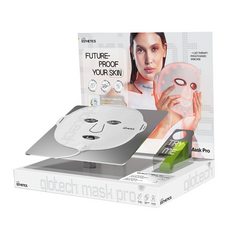
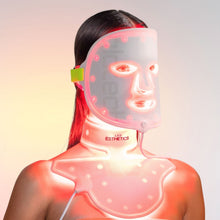
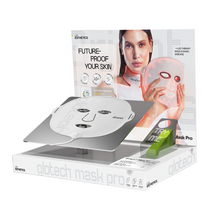
Glotech Mask Pro – Fully FDA-cleared as a medical device, and the most transparent option on this list about its regulatory status. It is cleared under the FDA classification "Light Based Over The Counter Wrinkle Reduction" (Product Code OHS, Regulation Number 878.4810), and its details are publicly listed in the FDA's database under Establishment Number 3011644607.
Beyond the paperwork, it is a Class II medical device running two treatment modes, anti-aging and anti-acne, across three clinically backed wavelengths: red at 630nm, near-infrared at 830nm, and blue at 415nm, delivered by 198 LEDs in a medical-grade silicone body.
Dr. Dennis Gross DRx SpectraLite FaceWare Pro – Cleared as an LED device combining red and blue light for wrinkles and acne, and one of the most recognised masks in the category.
Omnilux Contour Face – A well-studied, FDA-cleared flexible silicone mask using red and near-infrared light, frequently cited as a benchmark anti-aging device.
CurrentBody Skin LED Mask Series 2 – FDA-cleared, running dual red and near-infrared wavelengths for wrinkle reduction and skin rejuvenation.
MitoGLOW and similar clinical-grade masks – Cleared for full-face wrinkle treatment, with multi-wavelength options.
The pattern worth noticing is that the reputable, transparent brands tend to be the cleared ones. When a mask is genuinely cleared, the brand almost always states it clearly, uses the correct term, and can point to the specific indication, product code, or database listing. When a mask leans on vague regulatory language or an impressive-sounding colour count instead, that absence usually tells you something.
Why FDA Clearance Matters for LED Masks
It would be easy to dismiss all this as regulatory small print, but clearance has real, practical consequences for anyone buying and using an LED mask. Here is why it matters:
Verified safety
Clearance means the device's light output and safety profile have been reviewed, rather than taken on trust. Light shining directly onto your face and near your eyes is not something to leave to an unverified manufacturer.
Genuine, disclosed wavelengths
Cleared masks have to substantiate what they emit. Red, blue, and near-infrared are the wavelengths with real clinical backing, and clearance signals a device is using them as claimed rather than padding the count with unproven colours.
Eye safety standards
LED masks sit close to the eyes, and clearance involves meeting safety expectations that cheap, unverified masks may ignore entirely.
FSA and HSA eligibility
FDA clearance strengthens a claim for reimbursement through a Flexible Spending or Health Savings Account when treating a diagnosed condition, since it signals the device meets medical standards rather than being a pure beauty gadget.
A marker of overall quality
A brand willing to go through the clearance process is generally more transparent about its specifications, build, and testing than one that avoids it and leans on vague "FDA-registered" language instead.
In short, clearance is one of the clearest signals that a mask is a legitimate device rather than a repackaged novelty. It is not a guarantee of results, but it is a strong filter for weeding out the masks not worth your money.
How to Verify a Mask's FDA Clearance Yourself
You do not have to take any brand's word for it. The FDA maintains a free, public database of every cleared device, and checking a mask takes only a couple of minutes. Here is how:
-
Go to the FDA 510(k) database. Search online for the FDA's "510(k) Premarket Notification" database, hosted on the official fda.gov site. This is the definitive record of cleared devices.
-
Search by brand, device name, or manufacturer. Enter the mask's brand or the company that makes it. Note that some devices are listed under a parent company or a generic device name rather than the marketed product name, so try a few variations if the first search comes up empty.
-
Look for the K-number. Every cleared device has a clearance number beginning with “K” followed by digits (for example, K123456). If the device is genuinely cleared, this record will exist and will show key details including the device name (or a variation, as brands may update names after registration), applicant, clearance decision, and date.
-
Cross-check the intended use. The record will state what the device was cleared for, along with a product code (LED masks typically fall under code OHS for over-the-counter wrinkle reduction). A mask cleared for wrinkles is cleared for that specific use, which is exactly what you want to confirm.
-
Treat an empty result as a red flag. If you cannot find any record under the brand or its parent company, the "FDA-cleared" claim may not hold up. A genuinely cleared device will always appear in the database.
Red Flags to Watch For
Once you know what genuine clearance looks like, the warning signs become easy to spot. Be wary of a mask that shows any of these:
-
"FDA-registered" as a selling point – This refers to the facility, not the device, and tells you nothing about the product's safety or effectiveness.
-
No database record – A legitimate cleared device is always traceable in the FDA's public database under the device name or a variation of it, as brands may update names after registration.
-
A high count of unproven colours – Seven, eight, or ten-colour masks often lean on wavelengths with no clinical support. More colours is a marketing angle, not an upgrade.
-
Missing or vague specifications – No disclosed irradiance, no clear wavelengths, and no clearance detail together suggest a device selling on appearance rather than substance.
Final Thoughts
FDA clearance is one of the most useful filters you have when choosing an LED face mask, but only if you understand what the term actually means. Cleared is the standard that counts, approved is the wrong word for this category, and registered is close to meaningless for the device itself. The masks worth trusting are the ones that use the correct language, state their indication, and can be verified in the FDA's public database in a couple of minutes.
The Glotech Mask Pro pairs full FDA clearance and Class II medical status with dual anti-aging and anti-acne modes and fully disclosed wavelengths. Whichever you choose, prioritise a mask that is transparent about its clearance and specs, and verify it yourself. Your face, and your money, deserve that much certainty. If you want an FDA-cleared LED face mask that covers both anti-aging and acne in one, try the Glotech Mask Pro.